
Release time: 2026-03-24 Number of views: 590
The 2026 embedded hardware market is being pulled in several directions at once: cost pressure, currency swings and localization on one side, and AIoT demanding more compute at the edge on the other. For most OEMs, board selection is no longer a “shopping” decision; it is a long‑term architecture choice that can either absorb this volatility—or amplify it.
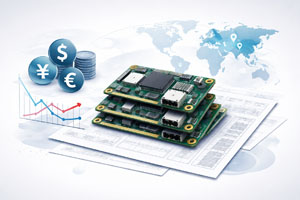
Raw material and BOM costs are still moving targets. Instead of chasing the lowest single price, more teams are asking a different question: Can this SoM survive a 7–10 year product life without forcing a redesign? That is why alternative‑ready footprints, second‑source memories and stable industrial‑grade components often win over the cheapest option on paper.
Currency risk adds another layer. When key processors and high‑end peripherals are priced in dollars or euros, a few percentage points of FX swing can erase a carefully calculated margin. In practice, this is pushing many customers toward dual‑sourcing strategies: the same carrier board must be able to accept either a globally sourced module or a more locally optimized version, depending on where the product is shipped and how the exchange rate behaves that year.
Localization goes beyond politics; it is now a supply‑chain survival tactic. More bids and tenders ask explicitly for domestically designed silicon or regionally supported ecosystems. That means design teams can no longer treat the BSP and middleware as an afterthought. If the software stack cannot be ported smoothly from an imported MPU to a domestic one, the theoretical “local alternative” never becomes a real option.
On paper, AIoT sounds simple: add some AI to an IoT node. On the ground, it means devices that used to log data and push it upstream are suddenly expected to run models, fuse multiple sensors and make decisions locally. A modest MCU that was perfectly fine five years ago now struggles to keep up, so many designs are stepping up to 64‑bit multi‑core MPUs with built‑in NPUs or DSP blocks.
Power and thermal limits have not disappeared just because workloads got heavier. Most edge devices still live in fanless boxes, sit on factory walls, or hide behind medical panels. That forces a much sharper focus on performance per watt. It is no longer enough to ask “How fast is this CPU?”; engineers also want to know “What happens to power and temperature when the NPU is running at full tilt for an hour?” The answer often determines whether a design passes long‑run reliability tests.
Security and connectivity are now part of the definition of a “good” SoM. Secure boot, hardware crypto, trusted execution and robust OTA mechanisms are table stakes for anything that ships in volume. At the same time, those boards still have to talk Modbus, CAN or EtherCAT on one side and Ethernet, Wi‑Fi or 5G on the other. Fitting all of that into a realistic power and cost envelope is where much of the real engineering work happens.
For customers, the hard part is not reading spec sheets; it is making trade‑offs that will still look reasonable in five years. A customization‑focused embedded hardware supplier can add value before the PCB is even routed: by mapping requirements to actual silicon roadmaps, highlighting which families are likely to stay in production, and where the realistic exit paths are if a chip goes end of life.
Instead of delivering a one‑off board, a good partner designs a small family: a shared carrier plus several pin‑compatible core modules that cover entry, mainstream and high‑end tiers. When FX moves or localization policies tighten, the customer can switch module variants—or even BOM versions—without touching plastics or certifications.
On the AIoT side, providing tuned power trees, thermal guidelines and ready‑to‑run BSPs matters as much as the hardware itself. When a customer can bring up a board, run their AI workload at target temperature, and see stable behavior within days rather than weeks, the risk profile of the whole project changes. And when component pricing or regulations shift mid‑life, having a supplier that already prepared alternative BOMs and migration notes can be the difference between a painful redesign and a controlled, documented update.
In short, 2026 is rewarding designs that are flexible by intent, not by accident. Low‑power, high‑performance SoM, combined with a customization partner who understands cost, FX and localization constraints, give OEMs a way to keep shipping products steadily—while the ground underneath continues to move

Keep up with our evolving product features and technologies. Enter your email and subscribe to our newsletter.

Copyright © 2020 https://www.embsom.com/